

When I first decided to buy cryptocurrency, I had no idea where to start. There were dozens of platforms, each claiming to be the best, the safest, the cheapest. The noise was overwhelming. Then a friend who had been trading for two years said one thing that cut through all the confusion: "Just start with Binance. Learn it properly, and everything else gets easier."
That was solid advice. Binance is not just another exchange. It is the largest cryptocurrency exchange in the world by trading volume, and it has built a reputation for offering a wide range of coins, competitive fees, and a platform that works for both complete beginners and professional traders. Whether you want to buy Bitcoin for the first time or explore advanced trading strategies, Binance has a path for you.
This guide is designed to walk you through everything you need to know about using Binance — from creating your account and verifying your identity, to buying your first cryptocurrency, withdrawing funds, understanding security measures, and exploring features you probably did not even know existed. By the end of this article, you will have a clear and practical understanding of how Binance works and how to use it confidently.
Let us get into it.

What Is a Cryptocurrency Exchange and Why Does It Matter?
Before we dive into Binance specifically, it helps to understand what a cryptocurrency exchange actually is and why choosing the right one matters so much.
A cryptocurrency exchange is an online platform that allows users to buy, sell, and trade digital assets like Bitcoin (BTC), Ethereum (ETH), and hundreds of other cryptocurrencies. Think of it as a stock exchange, but instead of trading company shares, you are trading digital currencies that exist on blockchain networks.
Not all exchanges are created equal. Some have poor security records. Others charge fees that quietly eat into your returns. Some are difficult to navigate, especially for beginners. And a few have been shut down entirely, leaving users unable to access their funds.
Choosing a reliable exchange is one of the most important decisions you will make as a crypto investor. It affects your security, your costs, the coins you can access, and the overall experience of managing your digital assets.
Binance has emerged as the dominant player in this space because it gets most of these factors right. It is not perfect — no exchange is — but it offers a combination of features that few competitors can match.
Getting Started: What You Need Before You Open a Binance Account
Setting up a Binance account is straightforward, but there are a few things you should have ready before you begin. Preparing these in advance will save you time and help you move through the process smoothly.
Things You Will Need
- A valid email address that you check regularly
- A strong, unique password you do not use on other platforms
- A government-issued ID (passport, national ID card, or driver's license)
- A smartphone for two-factor authentication
- A payment method (bank account or debit/credit card)
Once you have these ready, the registration and verification process typically takes between 15 and 30 minutes, though verification times can vary depending on how busy the platform is.
How to Create a Binance Account: Step-by-Step
Creating a Binance account is the first step on your crypto journey. Here is exactly how to do it.

Step 1 — Visit the Official Binance Website
Go to www.binance.com and click the "Register" or "Sign Up" button. Always make sure you are on the official website and not a phishing site. Check the URL carefully in your browser's address bar before entering any personal information.
Step 2 — Enter Your Email and Create a Password
You will be asked to enter your email address and create a password. Your password should be at least 8 characters long and include a mix of uppercase letters, lowercase letters, numbers, and symbols. Do not use passwords you have used on other websites.
Binance also gives you the option to sign up using your Google account, which can speed up the registration process. If you choose this route, just make sure your Google account itself has strong security settings, including two-factor authentication.
Step 3 — Verify Your Email Address
After submitting your registration details, Binance will send a verification code to your email address. Open your inbox, find the email from Binance, and enter the code on the registration page. If you do not see it within a few minutes, check your spam folder.
Step 4 — Complete Your Identity Verification (KYC)
This is where Binance takes an important step to protect both its users and the integrity of its platform. Before you can buy or sell any cryptocurrency, you will need to verify your identity through a process called KYC, which stands for Know Your Customer.
You will be asked to:
- Enter your full legal name and date of birth
- Provide your home address
- Upload a photo of a government-issued ID (passport, national ID, or driver's license)
- Take or upload a selfie to confirm that the ID belongs to you
Binance uses automated systems along with human review to verify your documents. In most cases, the verification is completed within minutes, though during periods of high demand, it may take a few hours.
Why Does Binance Require Identity Verification?
This is a question many new users ask, and it is a fair one. Nobody enjoys submitting personal documents to an online platform. But identity verification on cryptocurrency exchanges serves several critical purposes.
First, it is a legal requirement in most countries. Financial regulators around the world require cryptocurrency platforms to verify the identity of their users to prevent money laundering, terrorist financing, and other financial crimes. Compliance with these regulations is not optional — exchanges that fail to meet these standards risk being shut down by regulators.
Second, identity verification protects you as a user. If someone tries to gain access to your account, Binance can use your verified identity to confirm that you are the legitimate account holder. It also means that bad actors cannot easily open anonymous accounts to commit fraud.
Third, verified accounts typically have access to higher deposit and withdrawal limits. If you want to trade significant amounts of cryptocurrency, you will almost certainly need to complete full identity verification.
You can read more about KYC regulations and their role in cryptocurrency on the Financial Action Task Force (FATF) official website, which sets global standards for combating financial crime.
How to Fund Your Binance Account
Once your identity is verified, the next step is to add money to your account so you can start buying cryptocurrency. Binance offers several deposit methods, giving you flexibility depending on where you are located and what is most convenient for you.
Bank Transfer (SEPA or Local Bank Transfer)
Bank transfers are typically the cheapest way to fund your Binance account. Fees are usually low or even zero, and you can deposit larger amounts without hitting the limits that sometimes apply to card payments. The downside is that bank transfers can take anywhere from a few hours to several business days, depending on your bank and your location.
Credit or Debit Card
If you want to buy cryptocurrency immediately, a credit or debit card deposit is the fastest option. Binance supports Visa and Mastercard, and deposits are typically processed within minutes. The trade-off is that card transactions usually carry higher fees than bank transfers — typically around 1.8%, though this can vary.
Crypto Deposits
If you already hold cryptocurrency on another exchange or in a personal wallet, you can transfer it directly to your Binance account. To do this, navigate to your Binance wallet, find the coin you want to deposit, and copy your Binance deposit address. Then initiate the transfer from your other platform or wallet.
Always double-check that you are using the correct network when transferring cryptocurrency. Sending a coin on the wrong network can result in permanent loss of funds.
Third-Party Payment Providers
Binance also works with third-party providers like Simplex and Banxa, which allow you to purchase cryptocurrency using additional payment methods. These options can be useful if you are in a region where certain payment methods are not directly supported by Binance.
How to Buy Cryptocurrency on Binance
With funds in your account, you are ready to make your first cryptocurrency purchase. Binance makes this process simple, even for users who have never bought crypto before.
Using the "Buy Crypto" Feature
The easiest way to buy cryptocurrency on Binance is through the "Buy Crypto" section. Here is how it works:
- Log in to your Binance account
- Click on "Buy Crypto" in the top navigation menu
- Select your preferred payment method (card, bank transfer, etc.)
- Enter the amount you want to spend in your local currency
- Select the cryptocurrency you want to receive (Bitcoin, Ethereum, BNB, etc.)
- Review the exchange rate and fees
- Confirm your purchase
The cryptocurrency will appear in your Binance wallet within minutes.
Using the Spot Trading Market
If you are comfortable with a bit more complexity and want more control over the price you pay, the Spot Trading market gives you that flexibility. Instead of buying at the current market price, you can place limit orders — instructions to buy a specific cryptocurrency only when it reaches a price you define.
For example, if Bitcoin is trading at $45,000 and you believe it will dip to $42,000, you can set a limit order at $42,000. If the price drops to that level, your order will execute automatically. If it does not reach that price, your order simply remains open until you cancel it.
To access spot trading:
- Click on "Trade" in the top menu
- Select "Spot" from the dropdown
- Search for the trading pair you want (for example, BTC/USDT)
- Choose your order type (Market, Limit, or Stop-Limit)
- Enter the amount and confirm your order
The spot trading interface includes real-time charts, order books, and trade history, giving you all the information you need to make informed decisions.
How to Withdraw Money from Binance
Eventually, you will want to either move your cryptocurrency to a private wallet or convert it back to cash and send it to your bank account. Binance makes both options available, and the process is more straightforward than many new users expect.
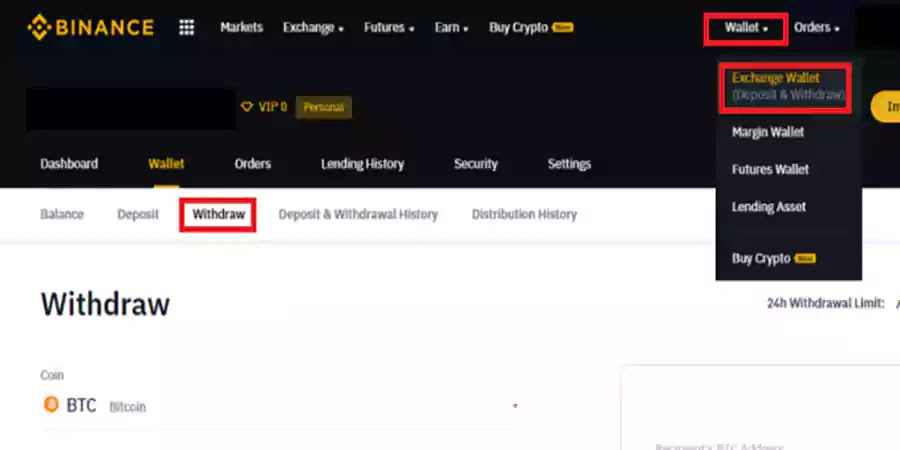
Withdrawing Cryptocurrency to an External Wallet
If you want to move your crypto off Binance and into a personal hardware or software wallet, follow these steps:
- Log in to your Binance account
- Click "Wallet" in the top menu, then select "Fiat and Spot"
- Find the cryptocurrency you want to withdraw and click "Withdraw"
- Enter the wallet address where you want to send your crypto
- Select the correct network (this is critical — using the wrong network can result in lost funds)
- Enter the amount you wish to withdraw
- Review all details carefully, then click "Submit"
- Confirm the withdrawal using the verification code sent to your email and, if enabled, your two-factor authentication code
Processing times vary by cryptocurrency. Bitcoin withdrawals, for example, typically take 10 to 30 minutes because they require blockchain confirmations. Some coins are much faster.
Withdrawing Cash (Fiat) to Your Bank Account
If you want to convert your cryptocurrency to cash and send it to your bank:
- First sell your cryptocurrency on Binance for a fiat currency (USD, EUR, etc.) using the "Sell Crypto" feature or the spot trading market
- Once you have fiat funds in your account, click "Wallet" and then "Fiat and Spot"
- Click "Withdraw" next to your fiat balance
- Enter your bank account details and the amount you want to withdraw
- Confirm the transaction
Bank withdrawals typically take 1 to 5 business days, depending on your bank and your country. Binance may also have daily withdrawal limits, so check your account settings if you need to move large amounts.
A Critical Warning About Withdrawals
Always verify the wallet address or bank details before confirming any withdrawal. Cryptocurrency transactions are irreversible. Once you send crypto to an address, there is no way to recover it if you made a mistake. Take an extra 30 seconds to double-check every detail. It is a habit that will save you from potentially catastrophic errors.
Is Binance Safe? A Realistic Look at Security
This is probably the most important question any crypto investor should ask before depositing money on any platform. Let me give you an honest answer rather than just a marketing pitch.
Binance is one of the most secure cryptocurrency exchanges available, but no exchange is completely invulnerable. In 2019, Binance suffered a significant hack where attackers stole approximately $40 million worth of Bitcoin. To the company's credit, Binance covered the losses in full from its Secure Asset Fund for Users (SAFU), and no user lost money. That incident, while concerning, actually demonstrated that Binance takes its responsibility to users seriously.
Since that hack, Binance has significantly upgraded its security infrastructure. Here is a breakdown of the key security measures currently in place:
Two-Factor Authentication (2FA)
Two-factor authentication adds a second layer of protection to your account. Even if someone obtains your password, they cannot log in without also having access to your authentication device. Binance supports both SMS-based 2FA and app-based 2FA using tools like Google Authenticator or Authy.
Always use app-based 2FA rather than SMS-based 2FA. SMS can be intercepted through SIM-swapping attacks, which are unfortunately common in the crypto space. An authenticator app is significantly more secure.
Cold Storage for the Majority of Assets
Binance stores the vast majority of user funds in cold storage wallets — systems that are completely disconnected from the internet. This means that even if Binance's online systems were compromised, most user funds would remain protected. Only a small percentage of assets are kept in "hot" wallets to facilitate daily withdrawals.
Secure Asset Fund for Users (SAFU)
Binance established the SAFU fund in 2018, allocating 10% of all trading fees to it as an emergency insurance reserve. This fund is designed to cover user losses in the event of a security breach. It currently holds hundreds of millions of dollars worth of assets.
Advanced Risk Management Systems
Binance uses machine learning and artificial intelligence to monitor for suspicious trading patterns and unauthorized account access. Unusual activity, such as a login from a new device or location, triggers additional verification requirements before any action can be taken.
Anti-Phishing Codes
Binance allows you to set up a personal anti-phishing code that will appear in all official emails from Binance. This helps you quickly identify whether an email is genuinely from Binance or a phishing attempt.
What You Can Do to Protect Yourself
Security is a shared responsibility. Even the best exchange cannot protect you if you make mistakes on your end. Here are the most important security practices to follow:
- Enable two-factor authentication immediately after creating your account
- Use a unique, strong password that you do not use on any other website
- Never share your password or 2FA codes with anyone, including people claiming to be Binance support staff
- Set up the anti-phishing code in your Binance security settings
- Be extremely cautious about clicking links in emails — always go directly to binance.com by typing it in your browser
- Consider using a hardware wallet for long-term crypto storage rather than keeping large amounts on the exchange
For further reading on cryptocurrency security best practices, the Cybersecurity and Infrastructure Security Agency (CISA) offers excellent general guidance on protecting your online accounts.
Beyond Buying and Selling: Advanced Features on Binance
Most people who sign up for Binance start with the basics — buying Bitcoin or Ethereum and watching the price. But Binance offers a rich ecosystem of features that can help you generate additional income from your crypto holdings or deepen your involvement in the market.
Margin Trading: Trading With Leverage
Margin trading allows you to borrow funds from Binance to trade with more money than you actually have in your account. For example, if you have $1,000 and use 5x leverage, you can open a position worth $5,000. If that position moves in your favor, your gains are amplified compared to what you would have earned without leverage.
However — and this cannot be emphasized strongly enough — leverage cuts both ways. If the market moves against you, your losses are also amplified. It is entirely possible to lose your entire account balance in a short period of time if you trade on margin without a clear risk management strategy.
Margin trading is not recommended for beginners. It is a tool for experienced traders who understand technical analysis, position sizing, and risk management. If you are new to crypto, start with straightforward spot purchases and learn the market before exploring margin.
Staking: Earning Passive Income From Your Crypto
Staking is one of the most popular features among longer-term crypto holders, and for good reason. It offers a way to earn a passive return on cryptocurrency you already own without having to trade or take on additional risk.
Here is how it works in simple terms: Some blockchains use a system called Proof of Stake (PoS) to validate transactions and create new blocks. In this system, validators are chosen based on how much cryptocurrency they "stake" — essentially lock up as collateral. As a reward for supporting the network, validators receive newly created cryptocurrency.
When you stake through Binance, you do not need to run a validator node yourself. Binance handles the technical side. You simply choose which cryptocurrency you want to stake, select a staking period, and lock your coins. In return, you receive regular rewards — similar to earning interest in a savings account, though the rates and risks are quite different.
Popular staking options on Binance include Ethereum (ETH), Cardano (ADA), and BNB. Annual percentage yields (APY) vary and change over time based on network conditions and the number of stakers on the platform.
One important thing to understand: staked funds are typically locked for a set period. During that time, you cannot sell or move your crypto. If the market drops significantly during your lock-up period, you will not be able to sell until the period ends. Factor this into your decision before committing funds to staking.
Crypto Lending: Putting Your Idle Assets to Work
Binance's lending feature allows you to lend your cryptocurrency to other users on the platform and earn interest in return. This is similar to staking in that it generates passive income, but the mechanics are different.
Borrowers on Binance typically use borrowed funds for margin trading. The interest they pay flows to lenders. Rates vary by cryptocurrency and by demand, and they change frequently.
Crypto lending carries some risk — specifically, the risk that a borrower defaults. However, Binance manages this risk through collateral requirements. Borrowers are required to put up more collateral than they borrow, and Binance automatically liquidates collateral if the borrowed position becomes too risky. This provides a layer of protection for lenders.
Airdrops: Earning Free Cryptocurrency
An airdrop is a distribution of free cryptocurrency tokens to users who meet certain criteria. Binance regularly runs airdrop campaigns, often in connection with new cryptocurrency projects launching on its platform.
The concept is straightforward: a new cryptocurrency project distributes tokens to existing crypto users to generate awareness and build an initial user base. By holding certain coins or simply having an active Binance account, you may qualify to receive free tokens.
Airdrops are generally low-risk opportunities for existing Binance users — you are receiving tokens you did not have before, which means your downside is zero. The value of the airdropped tokens can vary significantly, from essentially worthless to genuinely valuable, depending on the project.
Binance's Launchpad and Launchpool programs are the primary venues through which these opportunities are made available. Keeping an eye on the Binance announcements page is the best way to stay informed about upcoming airdrops.
Binance Futures: A Tool for Hedging and Speculation
Binance Futures allows users to trade cryptocurrency contracts rather than the actual coins themselves. Futures contracts let you speculate on whether a cryptocurrency's price will go up or down, and they can be used with leverage.
Like margin trading, futures are advanced instruments that carry significant risk. They are primarily used by professional traders and institutions who have sophisticated risk management strategies in place. If you are new to crypto, treat futures as something to explore much later in your journey, after you have built a solid understanding of the market.
Binance Earn: A Suite of Passive Income Tools
Binance Earn is an umbrella section of the platform that brings together several income-generating features, including:
- Flexible Savings: Deposit crypto and earn interest with the ability to withdraw at any time
- Fixed Savings: Lock your crypto for a set period in exchange for a higher interest rate
- Dual Investment: A structured product that lets you earn enhanced yields by combining a savings component with an options-like structure
- Binance Liquid Swap: A liquidity pool where you provide assets in exchange for a share of trading fees
Each of these options has a different risk profile and liquidity structure. The Binance Earn section of the platform provides clear information about expected returns and lock-up periods, allowing you to choose the option that fits your goals and risk tolerance.
The Benefits of Using Binance: Why It Stands Out
Given the number of cryptocurrency exchanges available today, what actually makes Binance worth choosing? Here is an honest look at the advantages that make it the most widely used exchange in the world.
The Largest Selection of Cryptocurrencies
Binance lists hundreds of cryptocurrencies — far more than most competing exchanges. Whether you are looking for established coins like Bitcoin and Ethereum, or you want to explore newer projects in DeFi, NFTs, or layer-two networks, Binance is likely to have what you are looking for.
This breadth of options is particularly valuable if you want to diversify your portfolio across multiple assets or if you are researching emerging projects before they become mainstream.
Exceptionally Low Trading Fees
Binance charges a standard spot trading fee of 0.1%, which is among the lowest in the industry. For comparison, many smaller exchanges charge 0.25% to 0.5% per trade, and some charge even more.
The difference might seem small, but over hundreds or thousands of trades, it adds up significantly. Lower fees mean more of your money stays invested rather than going to the exchange.
You can reduce your fees even further by holding Binance's native token, BNB (Binance Coin), and using it to pay trading fees. This gives you a 25% discount on all trades, bringing the effective fee down to 0.075%.
High Liquidity Across All Major Trading Pairs
Liquidity refers to how easily you can buy or sell an asset at a fair price. On a low-liquidity exchange, large orders can significantly move the price, meaning you might end up paying more than expected when buying or receiving less than expected when selling.
Binance handles billions of dollars in trading volume every day, making it one of the most liquid exchanges in existence. This means your orders are typically filled quickly and at prices very close to the market rate, regardless of whether you are trading $100 or $100,000.
A Well-Designed Mobile App
Binance's mobile app is available for both iOS and Android and gives you access to virtually everything available on the desktop platform. You can buy and sell crypto, monitor your portfolio, manage staking, and even access the full trading interface from your phone.
For most people, having a well-functioning mobile app is not a nice-to-have — it is essential. The ability to check your portfolio and react to market movements without being tied to a computer makes managing your investments significantly more practical.
Educational Resources for All Levels
Binance Academy is the exchange's free educational platform, offering hundreds of articles, videos, and courses covering everything from basic cryptocurrency concepts to advanced trading strategies, blockchain technology, and DeFi.
If you want to understand not just how to use Binance but why cryptocurrency works the way it does, Binance Academy is a genuinely valuable resource. You can access it at academy.binance.com.
Customer Support That Actually Responds
Customer support in the crypto industry has a poor reputation, and not without reason. Many exchanges have notoriously slow or unhelpful support teams. Binance has invested significantly in its support infrastructure, offering 24/7 chat support, an extensive help center with thousands of articles, and community forums where experienced users help answer questions.
That said, response times can still vary during periods of high market activity when support requests spike. For common issues, the Binance Help Center is often the fastest route to a solution.
Binance Smart Chain and the BNB Ecosystem
Binance operates its own blockchain — originally called Binance Smart Chain, now rebranded as BNB Chain — which hosts a large ecosystem of decentralized applications (dApps), DeFi protocols, and NFT marketplaces. BNB, Binance's native token, powers this ecosystem.
By using Binance and holding BNB, you are not just accessing an exchange — you are participating in a broader ecosystem with its own growth trajectory and use cases.
Potential Drawbacks of Binance: Keeping It Honest
No platform is without its weaknesses, and providing a balanced picture means acknowledging where Binance falls short.
Regulatory Uncertainty in Some Countries
Binance has faced regulatory scrutiny in several countries, including the United Kingdom, Japan, and others. In the United States, Binance operates a separate entity called Binance.US, which has a more limited range of features due to stricter regulatory requirements. Depending on where you live, some features may be restricted or unavailable.
Always check what features are available in your country before relying on specific Binance products.
The Interface Can Be Overwhelming at First
Binance's full platform is extraordinarily feature-rich, and that can be intimidating for someone who just wants to buy Bitcoin for the first time. The sheer number of options, charts, and menus can make it feel more complex than it needs to be for basic use.
The solution is to start with the simplified "Buy Crypto" flow and only explore the more advanced sections once you feel comfortable with the basics. Binance does offer both a "Lite" mode and a "Pro" mode in its mobile app to help with this, but the desktop interface still leans toward more experienced users.
Not the Best Option for US Residents
If you are in the United States, Binance.US offers a reduced feature set compared to the international platform. Many of the earning products, certain trading pairs, and some other features are not available through Binance.US. US residents who want access to the full Binance ecosystem may find the limitations frustrating.
Binance vs. Other Major Exchanges: A Quick Comparison
Understanding where Binance fits in the landscape of cryptocurrency exchanges helps you make a more informed decision about whether it is the right platform for your needs.
Binance vs. Coinbase
Coinbase is probably the most well-known exchange among beginner investors, particularly in the United States. It has a very simple interface and is often considered the easiest on-ramp into crypto for complete newcomers. However, Coinbase charges significantly higher fees than Binance, offers fewer cryptocurrency options, and has fewer advanced features.
Binance wins on fees, selection, and advanced features. Coinbase wins on simplicity and regulatory clarity for US users.
Binance vs. Kraken
Kraken is another well-established exchange with a strong security record. It offers a solid range of cryptocurrencies and is popular among more security-conscious users. However, Binance generally offers lower fees and a wider selection of coins. Kraken may be a better choice for users in the US or Europe who are concerned about Binance's regulatory situation.
Binance vs. KuCoin
KuCoin is often described as "the exchange for crypto enthusiasts" because it lists a very large number of smaller, newer cryptocurrencies — often before they appear on Binance. If you are specifically looking to trade small-cap or newly launched tokens, KuCoin can be a valuable complement to Binance. However, for the vast majority of users, Binance's larger liquidity and more robust security infrastructure make it the stronger choice.
Practical Tips for New Binance Users
After reviewing the platform from top to bottom, here are the most useful practical tips I would share with someone just getting started.
1. Enable All Security Features on Day One
Do not wait. Set up two-factor authentication, create your anti-phishing code, and review your account security settings before you deposit a single dollar. Security should be your first priority, not an afterthought.
2. Start Small
There is no pressure to invest large amounts right away. Start with an amount you are comfortable losing entirely — this is not because you expect to lose it, but because it removes emotional pressure and lets you learn the platform without high stakes. Once you understand how everything works, you can scale up your investments thoughtfully.
3. Do Not Leave Large Amounts on the Exchange
Exchanges are convenient, but they are not the safest place to store cryptocurrency long-term. If you are holding significant amounts, consider moving them to a hardware wallet like a Ledger or Trezor. This gives you full control over your private keys and eliminates the risk of losing funds if the exchange is compromised.
4. Use Dollar-Cost Averaging
Rather than trying to time the market — which even professional traders consistently fail at — consider using a strategy called dollar-cost averaging (DCA). This means investing a fixed amount of money at regular intervals regardless of the current price. Over time, this approach tends to reduce the impact of short-term volatility on your overall portfolio cost basis.
Binance supports recurring purchases, which makes implementing a DCA strategy easy and automatic.
5. Use Binance Academy to Learn Continuously
The more you understand about cryptocurrencies and the market, the better decisions you will make. Binance Academy at academy.binance.com is free and comprehensive. Make it part of your routine to read or watch one piece of educational content per week.
6. Track Your Taxes
In most countries, cryptocurrency trades are taxable events. This means every time you sell, trade, or convert cryptocurrency, you may owe taxes on any gains you made. Binance provides transaction history reports that you can use to calculate your tax liability, and tools like Koinly or CoinTracking can automate the process. Staying on top of your tax obligations from the beginning saves a lot of pain later.
Frequently Asked Questions (FAQ)
Is Binance legal to use?
In most countries, yes. However, Binance has faced regulatory challenges in some jurisdictions. Always check the legal status of cryptocurrency exchanges in your specific country before signing up. In the United States, Binance.US is the regulated entity for American users.
Does Binance charge fees for deposits?
Binance does not charge fees for cryptocurrency deposits. For fiat deposits (cash), fees depend on your payment method. Bank transfers are typically free or very low cost. Card deposits usually carry a fee of around 1.8%.
Can I use Binance without verifying my identity?
You can create an account and browse the platform without completing identity verification, but you will not be able to buy, sell, or withdraw until you complete the KYC process. Verification is mandatory for active trading.
What is BNB and do I need to buy it?
BNB is Binance's native cryptocurrency. You do not need to buy it to use Binance, but holding BNB gives you discounts on trading fees and access to certain exclusive opportunities on the platform. Many regular Binance users hold some BNB for the fee savings alone.
How long does it take to withdraw money from Binance?
Cryptocurrency withdrawals typically process within 30 minutes to a few hours, depending on the blockchain network involved. Fiat withdrawals to a bank account can take 1 to 5 business days, depending on your bank and country.
What happens if I lose access to my 2FA device?
If you lose access to your two-factor authentication device, you will need to go through Binance's account recovery process, which involves identity verification. This is why it is critical to save your 2FA backup codes when you set up your authenticator app. Store them securely offline.
Is my money insured on Binance?
Binance is not a bank, and your funds are not insured by government deposit insurance schemes like the FDIC in the United States. However, Binance maintains the SAFU (Secure Asset Fund for Users) as an internal insurance reserve to cover user losses in the event of a security incident.
Can I buy fractional amounts of Bitcoin on Binance?
Yes. You do not need to buy a whole Bitcoin. You can purchase fractions of Bitcoin and most other cryptocurrencies. The minimum purchase amount depends on the specific cryptocurrency and your payment method, but it is typically very accessible — often as low as $10 to $15.
What is the difference between Binance and Binance.US?
Binance.US is a separate platform operated for users in the United States to comply with US financial regulations. It offers fewer features and fewer cryptocurrency options than the international Binance platform. If you are a US resident, you will need to use Binance.US rather than the international platform.
Should I store my crypto on Binance or in a private wallet?
For small amounts or if you are actively trading, keeping crypto on Binance is perfectly reasonable. For larger holdings intended for long-term storage, a hardware wallet provides significantly better security because you control your own private keys. A popular phrase in the crypto community captures this well: "Not your keys, not your coins."
Conclusion: Is Binance the Right Exchange for You?
After everything covered in this guide, the answer for most people is yes — Binance is an excellent choice as a primary cryptocurrency exchange, particularly if you are looking for a platform that can grow with you as your knowledge and investment strategy mature.
It offers the largest selection of cryptocurrencies at the lowest fees, backed by institutional-grade security and an enormous amount of educational resources. Whether you want to simply buy and hold Bitcoin, explore passive income through staking and lending, or eventually move into more sophisticated trading strategies, Binance provides the tools to do all of that in one place.
The key is to approach it thoughtfully. Start with the basics. Enable your security features before anything else. Learn continuously. And never invest more than you can afford to lose — not because cryptocurrency is doomed to fail, but because the market is volatile and building discipline early will serve you well in the long run.
Cryptocurrency investing is a long game. Binance is a solid platform to play it on.
Ready to Get Started?
If you are ready to open your Binance account, head to www.binance.com, click "Register," and follow the steps outlined in this guide. Take your time with the identity verification process, set up all your security features, and make your first small purchase to familiarize yourself with how the platform works.
And if you want to deepen your understanding of the underlying technology before you invest, spend some time on Binance Academy — it is one of the best free educational resources in the crypto space.
Your journey into cryptocurrency starts with a single step. Take that step with confidence, curiosity, and a clear understanding of both the opportunities and the risks involved.

[email protected]